
Efoil Racing
FSRL eFoil Race Format
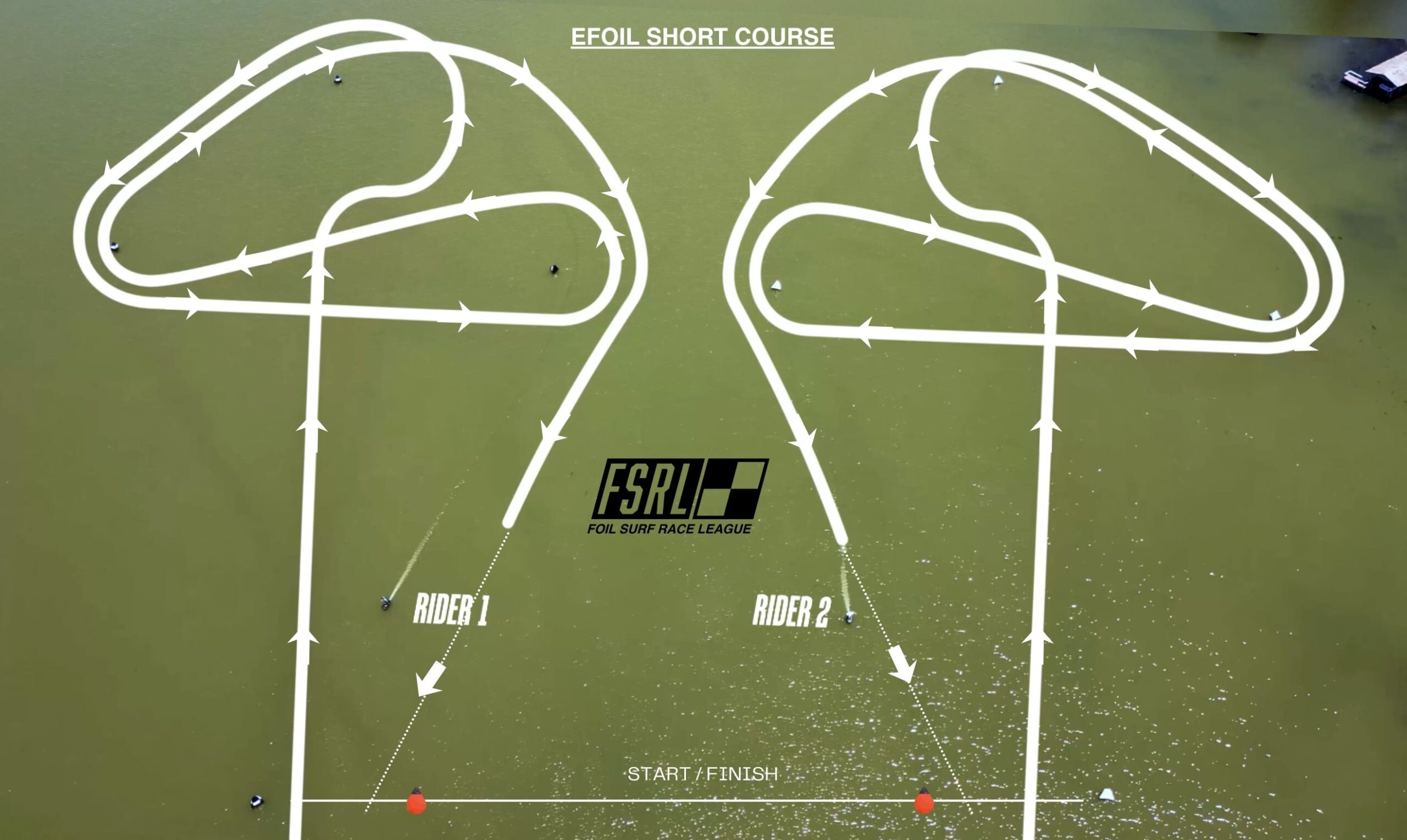
The FSRL eFoil Race is a head-to-head eFoil course race designed to be fast, competitive, tactical, and fair. The course has been designed to work equally well for regular-footed and goofy-footed riders while giving each rider course options depending on wind, water conditions, and personal riding style.
The event will begin with a round robin seeding format, followed by head-to-head semifinals and finals. Each heat will feature two riders at a time.
Course Format: We have two courses set up side by side. Each course is the exact same layout. This allows us to run head-to-head and round robin heats without needing to time every race. Riders race at the same time on identical courses, and the first rider to correctly complete the course and cross the finish line wins the heat.
Course Concept
Think of the course as an arrow. Riders start outside the course and enter through the start/finish line after the countdown and sounding horn. The first part of the course is a straightaway toward the tip of the arrow buoy. At the tip of the arrow, each rider chooses whether to begin the course with a left turn or a right turn.
The course is designed to include two long straightaways for maximum speed, three left turns, three right turns, and a 180-degree hairpin turn. This creates a balanced format that rewards speed, turning ability, board control, and race strategy.
Why riders start on foil: Riders start already on foil, so they do not need to prone start inside the race. This allows riders to use smaller, faster boards and wings while keeping the start clean and consistent.
Race Structure
1. Round Robin Seeding
Depending on how many competitors are in each division, the first round will be a round robin format. This gives riders the chance to race multiple times while trying to qualify out of their heat group and into the head-to-head semifinals and final.
Each round robin heat will have two riders. Riders will compete in multiple head-to-head races against different riders. The purpose of the round robin stage is to create fair seeding based on race performance before moving into the elimination rounds.
Round Robin Scoring
| Finish Position | Points |
|---|---|
| 1st Place | 3 points |
| 2nd Place | 1 point |
| Did Not Finish / Disqualification / OCS Loss | 0 points |
After all round robin races are complete, riders will be ranked by total points.
Round Robin Tiebreakers
Tiebreakers will be decided in the following order:
- Head-to-head result between tied riders
- Most first-place finishes
- Additional tie-break race, if needed
- Race director decision
Head-to-Head Bracket Racing
After the round robin seeding is complete, riders will move into head-to-head elimination racing. Higher-seeded riders will be matched against lower-seeded riders based on the bracket layout.
Winners advance through the bracket until the final race determines the overall winner.
| Example Matchup | Riders |
|---|---|
| Race 1 | Seed 1 vs Seed 8 |
| Race 2 | Seed 2 vs Seed 7 |
| Race 3 | Seed 3 vs Seed 6 |
| Race 4 | Seed 4 vs Seed 5 |
| Round | Description |
|---|---|
| Round Robin | Seeding round where riders race multiple head-to-head heats |
| Semifinals | Top riders advance into head-to-head elimination heats |
| Final | Determines 1st and 2nd place |
| Consolation Final | Race for 3rd and 4th place |
Start Procedure
Riders will begin outside the course and must be in the water before the start sequence begins. Once both riders in the heat are in the water outside the course, the race director will start a 24-second shot clock.
During the 24-second shot clock, riders may get up on foil, position themselves, and prepare for the start. Riders may not cross into the course before the starting horn.
The final 5 seconds will be counted down on the start clock. At the end of the countdown, a horn will sound to officially start the race.
| Time | Signal / Rider Action |
|---|---|
| 24 seconds | Shot clock begins once both riders are in the water outside the course |
| 24 to 6 seconds | Riders get on foil and position for the start |
| 5 seconds | Final countdown begins on the start clock |
| 0 seconds | Horn sounds — race starts |
Important: If a rider crosses into the course before the horn, that rider will be considered OCS. The rider must return fully behind the start line and restart correctly before continuing the race.
OCS — Over Course Side
A rider is considered OCS, or Over Course Side, if any part of the rider, board, or foil crosses into the course or crosses the start line before the starting horn.
Riders may approach and time the start, but they must remain outside the course and behind the start line until the horn sounds.
OCS Signal Procedure
If a rider is judged to be OCS, the race official will immediately signal the violation.
The official OCS signal will be a red flag waved and pointed at the OCS rider, along with a siren or horn sounded to alert the rider, the other competitor, and race officials.
OCS Restart Requirement
If a rider is OCS, that rider must return fully to the restart side of the start line before continuing the race.
To clear an OCS call, the rider must:
- Safely turn back
- Return completely behind the start line
- Re-cross the start line after the starting horn has sounded
Once the rider has properly returned behind the start line and restarted, they may continue racing.
Failure to Clear OCS
| Infraction | Penalty |
|---|---|
| OCS rider returns and restarts correctly | Race continues |
| OCS rider fails to return behind the line | Loss of race |
| OCS creates a clear unfair advantage | Loss of race or disqualification |
| OCS creates contact or a safety issue | Disqualification |
Course Completion
Riders must complete the full course in one of the approved directions. Missing a buoy, cutting inside a required turn, failing to complete the hairpin turn, or failing to pass through the finish correctly may result in loss of heat or disqualification.
Once a rider commits to a course direction, they must complete that direction correctly.
Course Direction Options
Once both riders are in the course and racing, the first part of the course is a straightaway toward the tip of the arrow buoy. This is where each rider decides if they want to start with a left turn or a right turn.
Left Turn Start
For a left turn start, the rider goes left around the first buoy at the top of the arrow, then drives to the outside left buoy and makes another left turn toward the outside right buoy.
At the outside right buoy, the rider completes their last left turn with a 180-degree hairpin turn back toward the outside left buoy. At the outside left buoy, the rider makes their first right turn.
The rider then continues making right turns around the tip of the arrow buoy and the right outside buoy. After completing the required turns, the rider sprints back to the start/finish line.
Right Turn Start
For a right turn start, the rider goes right around the first buoy at the top of the arrow, then drives to the outside right buoy and makes another right turn toward the outside left buoy.
At the outside left buoy, the rider completes their last right turn with a 180-degree hairpin turn back toward the outside right buoy. At the outside right buoy, the rider makes their first left turn.
The rider then continues making left turns around the tip of the arrow buoy and the outside left buoy. After completing the required turns, the rider sprints back to the start/finish line.
Course Summary: This format gives riders two long straightaways for maximum speed, three left turns, three right turns, and one 180-degree hairpin turn. It is designed to be competitive, fair, and tactical while giving riders options based on wind, water conditions, and riding preference.
General Race Rules
Right of Way and Contact
Avoiding contact is the responsibility of both riders. A rider who creates contact, forces another rider to crash, or rides in an unsafe manner may be penalized or disqualified.
Riders may not intentionally block, swerve, or force contact with other riders.
Falls
If a rider falls, they may continue the race as long as they safely restart and complete the course.
A fallen rider must not interfere with the other rider still racing.
Finish
The finish is determined when the rider’s mast crosses the official finish line.
In the event of a photo finish, the rider whose mast crosses the finish line first wins.
Race Director Authority
The race director has final authority over course setup, start calls, OCS calls, penalties, safety decisions, restarts, and final results.
The race director may modify the format as needed due to rider count, weather, water conditions, safety, or time constraints.
*The FSRL race format, written rules, diagrams, course layouts, scoring materials, branding, logos, and related event materials are proprietary materials of Foil Surf Race League. No portion may be copied, reproduced, published, or used for commercial event production without written permission. Nothing herein grants permission to use the FSRL name, marks, logos, or official race materials.